
Core Kubernetes Topics


- Kubernetes Commands Every DevOps Engineer Must Know
- Mastering essential Kubernetes commands is vital for managing containerized applications. Key commands include:
kubectl getto retrieve information about resources like pods and services.kubectl describeto get detailed information about a specific resource.kubectl applyto apply configuration changes from a YAML file.kubectl deleteto remove resources. Familiarity with these commands enables efficient management and troubleshooting of Kubernetes resources.
- Mastering essential Kubernetes commands is vital for managing containerized applications. Key commands include:
- Kubernetes Architecture Crash Course
- Understanding Kubernetes architecture involves knowing its core components:
- Control Plane: Manages the Kubernetes cluster, including the API server, etcd (key-value store), scheduler, and controller manager.
- Nodes: Worker machines that run containerized applications. Each node contains a Kubelet, which communicates with the control plane, and a container runtime (like Docker).
- Pods: The smallest deployable units in Kubernetes, representing one or more containers. Understanding how these components interact is crucial for deploying and scaling applications.
- Understanding Kubernetes architecture involves knowing its core components:
- Kubernetes Autoscaling – HPA vs VPA vs KEDA
- Autoscaling ensures applications can handle varying loads efficiently:
- Horizontal Pod Autoscaler (HPA): Automatically scales the number of pods based on CPU utilization or other select metrics.
- Vertical Pod Autoscaler (VPA): Adjusts the resource requests and limits of existing pods based on usage.
- KEDA (Kubernetes Event-Driven Autoscaling): Scales pods based on external events or metrics, such as messages in a queue. Understanding when and how to implement these autoscalers is key to optimizing resource use.
- Autoscaling ensures applications can handle varying loads efficiently:
- Kubernetes Upgrades – How Not to Mess Up?
- Upgrading Kubernetes clusters requires careful planning to avoid downtime:
- Backup: Always back up etcd and application data before upgrading.
- Staging Environment: Test upgrades in a staging environment to identify potential issues.
- Rolling Updates: Use rolling updates to upgrade applications gradually, ensuring availability. Familiarity with these strategies helps maintain service continuity during upgrades.
- Upgrading Kubernetes clusters requires careful planning to avoid downtime:
- Kubernetes Operator vs Helm – Which One to Choose?
- Both Operators and Helm serve different purposes in application management:
- Operators: Custom controllers that manage the lifecycle of complex applications on Kubernetes. They automate tasks like scaling, backups, and updates.
- Helm: A package manager for Kubernetes that simplifies deployment and management of applications through reusable charts. Understanding the strengths of each allows for better application lifecycle management.
- Both Operators and Helm serve different purposes in application management:
- Kubernetes Cluster Level Logging Architectures
- Implementing logging solutions is essential for monitoring and troubleshooting:
- Use tools like Fluentd, Elasticsearch, and Kibana (EFK stack) or Prometheus and Grafana for logging and monitoring.
- Centralized logging helps in aggregating logs from multiple pods and nodes, making it easier to identify issues and analyze performance.
- Implementing logging solutions is essential for monitoring and troubleshooting:
- How a Pod is Deleted – Behind the Scenes Breakdown
- Understanding pod deletion involves knowing the lifecycle:
- When a pod is deleted, Kubernetes performs a graceful termination, sending a SIGTERM signal to the containers.
- The pod enters a “Terminating” state, allowing containers to clean up resources before being removed. This knowledge is crucial for designing resilient applications.
- Understanding pod deletion involves knowing the lifecycle:
- Multi-Cluster Batch Job Scheduling Now a Reality with Kueue
- Kueue provides a way to manage batch jobs across multiple Kubernetes clusters:
- It enables efficient scheduling and resource allocation for batch jobs, improving resource utilization and reducing costs.
- Understanding how to set up and configure Kueue can help teams manage workloads more effectively in a multi-cluster environment.
- Kueue provides a way to manage batch jobs across multiple Kubernetes clusters:
- Kubernetes Troubleshooting
- Developing troubleshooting skills is essential for maintaining application health:
- OOMKilled: Understand memory limits and adjust resource requests.
- ImagePullBackOff: Check image repository credentials and ensure the image exists.
- Node Disk Pressure: Monitor disk usage and clean up unused resources.
- CreateContainerConfigError/CreateContainerError: Investigate configuration files and environment variables. Mastering these troubleshooting techniques ensures quick resolution of common issues.
- Developing troubleshooting skills is essential for maintaining application health:
Terraform and Infrastructure as Code
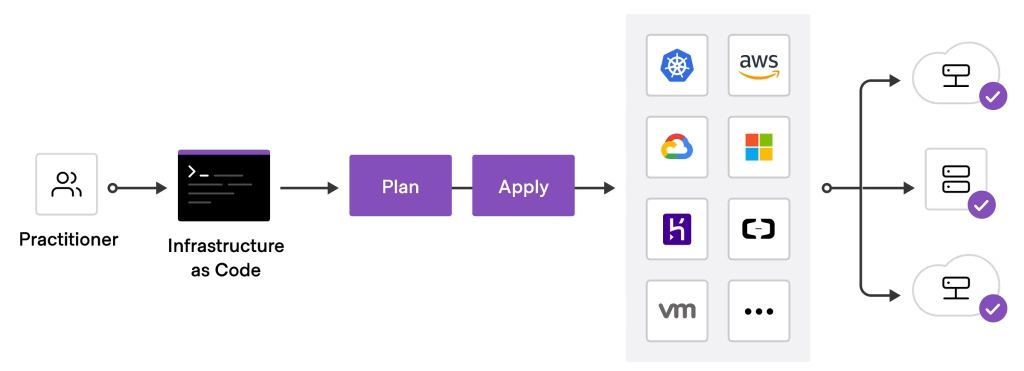
- Terraform Components Eco System Crash Course
- Terraform is a powerful Infrastructure as Code (IaC) tool:
- Providers: Plugins that allow Terraform to interact with cloud providers and services (e.g., AWS, Azure).
- Modules: Reusable configurations that help organize code and promote best practices.
- State Management: Understanding how Terraform manages state files is crucial for tracking resource changes and ensuring consistency.
- Terraform is a powerful Infrastructure as Code (IaC) tool:
- Guide to a Well Structured Terraform Project
- Structuring Terraform projects effectively enhances collaboration and maintainability:
- Use directories to separate environments (e.g., development, production).
- Adopt naming conventions and documentation practices to clarify resource purposes.
- Implement version control to track changes and facilitate collaboration among team members.
- Structuring Terraform projects effectively enhances collaboration and maintainability:
AWS and Cloud Services

- Simplifying AWS Data Transfer Costs
- Data transfer costs can significantly impact cloud spending:
- Explore strategies like using Amazon CloudFront for content delivery, optimizing S3 bucket configurations, and understanding data transfer pricing models.
- Implementing these strategies can lead to substantial cost savings while maintaining performance.
- Data transfer costs can significantly impact cloud spending:
- Designing Least Privilege AWS IAM Policies
- Security is paramount in cloud environments:
- IAM policies should grant only the permissions necessary for users and services to perform their tasks.
- Implementing least privilege principles reduces the risk of unauthorized access and potential security breaches.
- Security is paramount in cloud environments:
- AWS Internet Gateway vs NAT Gateway – Which One to Choose?
- Understanding network architecture is essential for designing secure and efficient applications:
- Internet Gateway: Allows communication between instances in a VPC and the internet.
- NAT Gateway: Enables instances in a private subnet to access the internet while preventing inbound traffic. Choosing the right gateway depends on application requirements and security considerations.
- Understanding network architecture is essential for designing secure and efficient applications:
- Cloud Disaster Recovery Strategies
- Planning for disaster recovery is critical for business continuity:
- Develop strategies that include data backups, failover mechanisms, and recovery plans.
- Regularly test disaster recovery plans to ensure they work effectively in real scenarios.
- Planning for disaster recovery is critical for business continuity:
- Hexagonal Architecture in AWS
- Hexagonal architecture promotes separation of concerns:
- This design pattern allows applications to be decoupled from external systems, improving maintainability and testability.
- Implementing hexagonal architecture in AWS can enhance application scalability and resilience.
- Hexagonal architecture promotes separation of concerns:
- Why You Need a Kubernetes Controller
- Controllers are essential for managing the state of Kubernetes resources:
- They continuously monitor the cluster and make adjustments to ensure the desired state matches the actual state.
- Understanding how controllers work is crucial for building custom controllers to manage specific application needs
- Controllers are essential for managing the state of Kubernetes resources:
CI/CD and GitOps

- Conventional Vs Kubernetes CI/CD Pipelines
- CI/CD practices differ between traditional and Kubernetes environments:
- Conventional pipelines often rely on VM-based deployments, while Kubernetes pipelines leverage containerization for faster and more reliable deployments.
- Familiarity with both approaches allows teams to choose the best practices for their specific environments.
- CI/CD practices differ between traditional and Kubernetes environments:
- GitHub Branching Strategy for Multi Account Environments
- Effective branching strategies are essential for collaboration:
- Implementing strategies like GitFlow or trunk-based development can help manage code changes across multiple accounts and teams.
- Clear branching policies reduce conflicts and enhance code quality.
- Effective branching strategies are essential for collaboration:
- GitHub Actions Optimization Techniques
- Optimizing GitHub Actions workflows can lead to more efficient CI/CD processes:
- Techniques include caching dependencies, using matrix builds to test multiple configurations, and minimizing redundant steps.
- These optimizations can significantly reduce build times and improve deployment speed.
- Optimizing GitHub Actions workflows can lead to more efficient CI/CD processes:
- Multi-Cloud GitOps Workflow for Kubernetes Management
- GitOps simplifies Kubernetes management across multiple cloud providers:
- By using Git as the single source of truth for deployments, teams can manage infrastructure and applications efficiently.
- Understanding how to implement GitOps practices allows for agile and consistent deployments across diverse environments.
- GitOps simplifies Kubernetes management across multiple cloud providers:
Performance and Cost Optimization
- How Levels.fyi Cuts Cloud Bill By 15%
- Learning from companies that successfully optimize cloud spending can provide valuable insights:
- Techniques may include rightsizing resources, leveraging reserved instances, and automating cost management practices.
- Implementing similar strategies can lead to significant cost reductions while maintaining performance.
- Learning from companies that successfully optimize cloud spending can provide valuable insights:
- Best DevOps Tools That Are Good for the Planet
- Sustainability is becoming increasingly important in DevOps:
- Identifying and using tools that promote environmental sustainability, such as those that optimize resource usage or reduce energy consumption, can help organizations minimize their carbon footprint.
- Sustainability is becoming increasingly important in DevOps:
Advanced Topics
- Azure Durable Function Patterns
- Azure Durable Functions enable serverless applications to maintain state:
- Patterns like function chaining, fan-out/fan-in, and asynchronous HTTP APIs allow developers to build complex workflows.
- Understanding these patterns enhances the ability to create scalable serverless applications.
- Azure Durable Functions enable serverless applications to maintain state:
- Dockerfile vs. Docker Compose: What You Should Know
- Both Dockerfiles and Docker Compose serve distinct purposes in containerization:
- Dockerfile: A script for building a Docker image, defining how the application is packaged.
- Docker Compose: A tool for defining and running multi-container applications, allowing for easier orchestration of services. Knowing when to use each is essential for effective container management.
- Both Dockerfiles and Docker Compose serve distinct purposes in containerization:
By diving deep into these topics, aspiring DevOps and Cloud engineers can develop a robust skill set that prepares them for the challenges of modern software development and cloud management. This comprehensive approach ensures they are well-equipped to implement best practices and drive successful DevOps transformations within their organizations.
Kubernetes troubleshooting
1) How To Fix OOMKilled
2) Kubernetes ImagePullBackOff Explained
3) Kubernetes RunContainerError Explained
4) Understanding Kubernetes CreateContainerConfigError
5) Understanding Kubernetes CreateContainerError
6) How to Fix Kubernetes Node Disk Pressure
7) How To Fix Kubernetes Node Not Ready
Kubernetes Troubleshooting Cheat Sheet