
Azure Cloud is recognized for its flexibility, cost-effectiveness, and user-friendly nature, making it an ideal platform for businesses. In 2020, Microsoft enhanced the Azure experience by introducing Azure Bicep, a new tool designed to streamline cloud infrastructure deployment.
If your organization uses Azure or is considering a migration to the cloud, understanding the benefits of Azure Bicep is essential for deploying infrastructure effectively.
What is Azure Bicep?
Before exploring the advantages of Azure Bicep, it’s important to clarify what it is. Bicep is a language developed by Microsoft specifically for deploying Infrastructure as Code (IaC) within Azure.
Understanding Infrastructure as Code
Historically, system administrators managed IT infrastructure through tedious manual processes. IaC solutions like Azure Bicep enable you to manage and provision infrastructure programmatically.
The benefits of Infrastructure as Code include:
- Enhanced efficiency through automation
- Reduced costs for human resources and hardware
- Consistency and decreased errors
- Version control
- Better documentation
These advantages make IaC a fundamental aspect of the Microsoft Cloud Adoption Framework for Azure, which consists of best practices, documentation, and tools to help organizations achieve their cloud objectives.
What About ARM?
If you’re familiar with Azure, you likely know about Azure Resource Manager (ARM). ARM templates are JSON-based files that outline your cloud deployment, similar to Bicep, which is also a form of Infrastructure as Code.
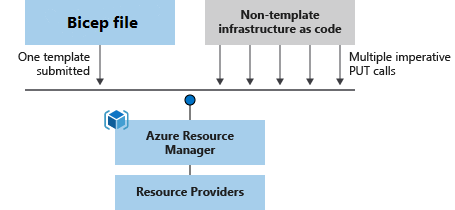
However, Azure Bicep does not replace ARM; instead, it acts as a user-friendly abstraction over ARM. When you deploy a Bicep file, the Bicep CLI converts it into an ARM template, which then manages the resource deployment in Azure. Thus, Azure Bicep can perform all the functions of ARM, and it offers several advantages over it.
5 Benefits of Azure Bicep
- User-Friendly Learning Curve
While ARM templates offer extensive capabilities, they often become lengthy, complex, and unwieldy. In contrast, Bicep files feature a more straightforward syntax, often reducing the length of code by half compared to ARM templates. Many users appreciate the enhanced authoring experience provided by the Visual Studio Code extension, which includes features like snippets, tab completion, syntax highlighting, and hover functions. - Support for Modularity
Bicep allows you to break your code into smaller, manageable modules, each responsible for deploying a specific set of resources. This modularity simplifies development and enables code reuse across projects, making it easy to add modules for specific resources as needed. - Automatic Dependency Detection
When creating an ARM template, you must manually define dependencies between resources. Bicep, however, automatically identifies implicit dependencies, saving time and reducing the risk of errors. - Microsoft-Backed Language
Being an Azure-specific tool, Bicep is developed by Microsoft, ensuring seamless integration with existing Azure resources such as Azure Policy, template specs, and Blueprints. Additionally, Bicep will always receive immediate support for new resources and API versions, eliminating the wait associated with third-party tools. - Cost-Free
Despite its numerous advantages, Azure Bicep is completely free and open-source, unlike some competitors that require premium subscriptions.
Alternatives to Azure Bicep
While Bicep is a powerful tool for deploying Azure resources, it’s not the only option. You could continue using ARM templates or explore third-party tools like Terraform.

Azure Bicep vs. ARM
We’ve discussed how Bicep enhances the user experience compared to ARM. If you already manage your cloud infrastructure with ARM templates, you may wonder if transitioning to Bicep is worthwhile. The good news is that you can easily decompile your ARM templates into Bicep, allowing you to update your existing complex templates using Bicep’s simpler syntax.
Azure Bicep vs. Terraform
Terraform is a popular alternative to Bicep, utilizing Hashicorp Configuration Language (HCL) for IaC. It is multi-platform, enabling use with AWS and other cloud providers in addition to Azure, which may be advantageous for some organizations. However, for those exclusively using Azure, Bicep presents significant benefits.
As a third-party tool, Terraform may not provide immediate support for new Azure resources like Bicep does. Additionally, while Bicep is free, Terraform often requires a premium subscription for access to key features. Furthermore, Terraform necessitates state files for configuration data storage, which can complicate maintenance, whereas Bicep directly stores all data in Azure, eliminating this requirement.
For more information: https://learn.microsoft.com/en-us/azure/azure-resource-manager/bicep/overview?tabs=bicep